The Halfway Truth
Here's what we're sensing in creative businesses right now. The halfway point isn't about achievement. It's about energy.
And energy is never just about workload. It's about attention, confidence, trust, recovery. All the things that let people show up on the second day, after a difficult first day. The things that let them think creatively when the brief is tight.
When energy erodes, everything else follows.
But nobody talks about it at mid-year. Because energy is invisible until it's gone.
What Energy Erosion Looks Like
You don't see it in the numbers. You see it in the micro-behaviours.
Cameras stay off more often. Not because people don't care. Because protecting energy has become the priority.
Fewer new ideas in meetings. People contribute when asked. But stop initiating. Stop exploring. Stop wondering "what if."
More "fine" in responses. "How's it going?" "Fine." Not "good," not "busy," just "fine."
Faster agreements. Decisions that would normally spark debate get nodded through.
More task focus, less curiosity. The work gets done. But it's execution-focused. Heads-down.
These aren't quirks. They're signals.
And signals tell you what the numbers won't.
Why Mid-Year Matters
Most creative businesses treat mid-year like a checkpoint. But it's actually a diagnostic moment.
Because six months is long enough for patterns to emerge. Long enough for the reality of energy to show up in how people actually work. Long enough for drift to become obvious.
And here's the thing: if you notice energy erosion at month six, you can course-correct before month twelve. You can adjust the plan. Redistribute the load. Protect the second half differently.
Most businesses don't. They push forward with the original goals. Assume people will find more reserves somewhere. Treat fatigue like a motivational problem instead of a structural one.
How The Halfway Truth Shows Up
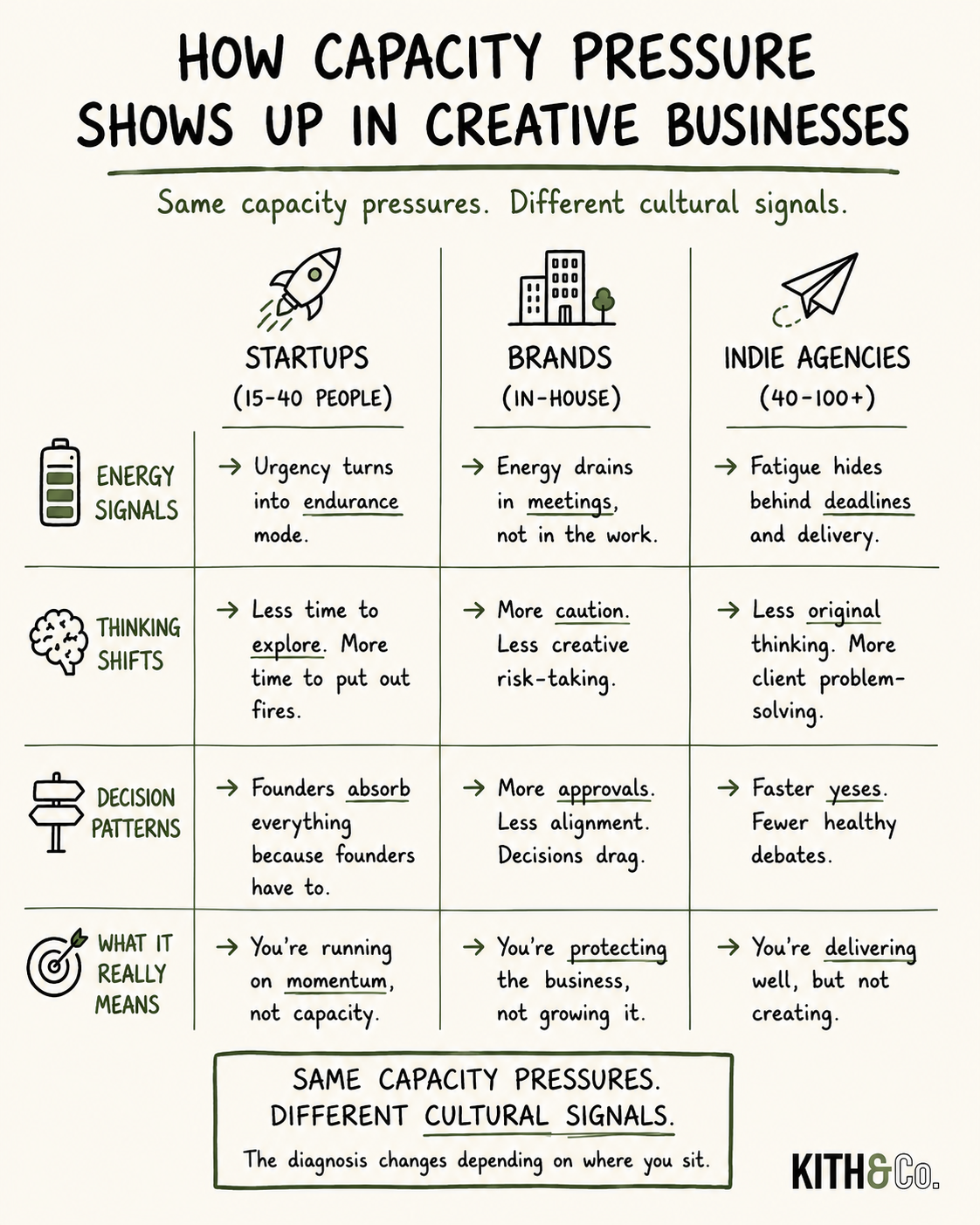
The pattern is the same across creative environments. But the pressure point is never the same.
In startups, urgency becomes the default. Founders absorbing the load because founders have to.
In brands, caution replaces creativity. More layers, more approvals, less bold thinking.
In agencies, fatigue from always being on. Creative directors in every meeting. Client pressure constant.
Same halfway moment. Different contexts. Different breaking points.
The Halfway Truth
Same capacity pressures. But the diagnosis changes depending on where you sit.
The Headroom Gap
January planning assumes headroom stays the same. But it never does.
Four months in, people are tired from onboarding. Tired from learning new briefs. Tired from the pace that felt sustainable but wasn't. Tired from solving problems nobody predicted.
Five months in, burnout isn't a word yet. But it's flagging in the micro-behaviours.
Six months in? The question becomes: can we actually do what we planned? Or do we need to adjust?
Research shows that goal failure rarely comes from lack of ambition. It comes from ignoring energy changes. When teams set goals in January, they forecast based on "normal" workload. But by June, normal has shifted. Budget might have tightened. A team member left. Client demands intensified. New projects arrived unplanned.
The energy equation changed. But the goal didn't.
What May Have Shifted Since January?
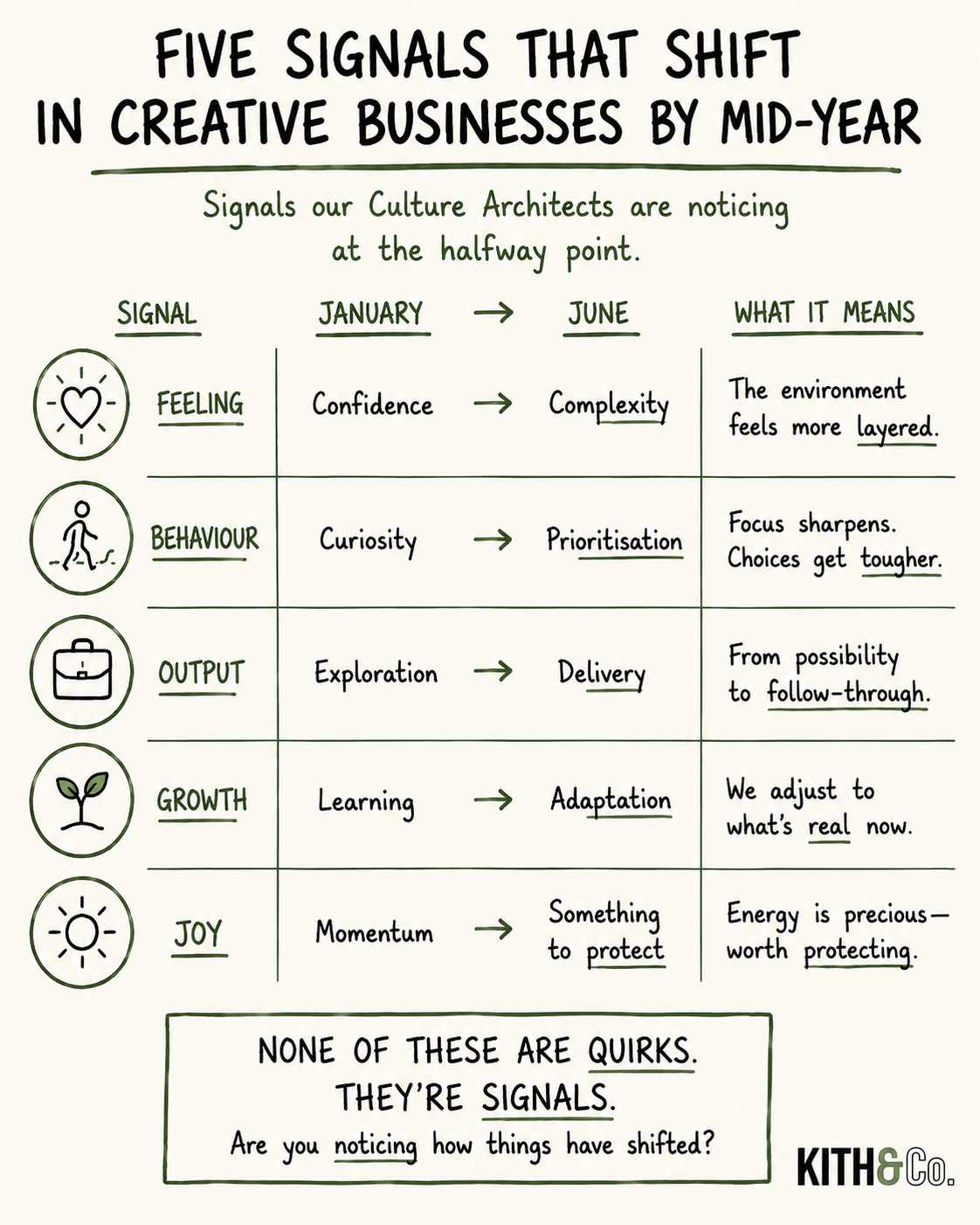
By mid-year, five signals have almost always shifted.
The way we feel about the work changes. Confidence becomes complexity. The environment feels more layered.
How we behave shifts. Curiosity becomes prioritisation. Focus sharpens, choices get tougher.
What we produce changes shape. Exploration becomes delivery. From possibility to follow-through.
How we grow adapts. Learning becomes adaptation. We adjust to what's real now.
And what brings us joy requires protection. Momentum becomes something to protect. Energy is precious, worth protecting.
The Halfway Truth
None of these are problems. They're signals. And the strongest leaders are the ones noticing how things have shifted.
How to Read Mid-Year Signals
Look for the micro-behaviours. They're your diagnostic lens.
If cameras are off: People are protecting their energy. They don't have organisational load left.
If ideas are quieter: People are thinking tactically, not strategically. Creative bandwidth has been redirected to delivery.
If agreement is faster: People are operating in scarcity. Pushing back costs attention they don't have.
If challenge is softer: Teams are in preservation mode. Available thinking space is shrinking.
If "fine" is the answer: Recovery capacity is lower. People are managing, not thriving.
This doesn't mean panic. It means: notice. Acknowledge. Adjust.
What Energy-Conscious Leadership Looks Like
It's not about pushing harder. It's about asking different questions at mid-year.
Not: "Are we on track?" But: "Do people still have enough left in the tank?"
Not: "Who can do more?" But: "What can we stop doing?"
Not: "Let's push to the finish line." But: "What needs replenishing before H2 begins?"
The businesses that thrive in the second half aren't the ones that deny fatigue. They're the ones that acknowledge it. That adjust timelines. That protect recovery. That redistribute cognitive load. That treat energy like the infrastructure it is.
The Second-Half Conversation
The halfway point is your moment to have this conversation. Because the good news: energy erosion isn't permanent. It's a signal, not a sentence.
With different choices in the second half, people can recover. Attention can rebuild. Creativity can come back online.
But it requires noticing the micro-behaviours. Reading the signals. Adjusting the plan around what's actually possible, not what was hoped for six months ago.
That's the halfway truth. Not "we're halfway there and everything's fine." But "we're halfway there, and it's time to get honest about energy."
Where To Start
Mid-year review season is here. Before you review performance, review headroom.
Ask your teams:
Where has your attention shifted since January?
What felt sustainable that isn't?
What recovery do you need before H2?
What would help you show up differently in the second half?
Listen for the micro-behaviours in how they answer. Notice what they say and what they don't say.
That's your diagnostic.
Most partnerships with KITH&Co. start with a Culture Intelligence Audit. A clear way to understand what's really happening beneath the surface.
If this is landing, it's worth exploring together.